ReSound Vivia 9 vs Starkey Omega AI 24: A Flagship Face-Off Worth Having
TL;DR: The ReSound Vivia 9 vs Starkey Omega AI 24? Two of the most advanced hearing aids available. Both are current-year flagships with serious AI


Updated February, 2026
TL;DR: Rechargeable hearing aids use built-in lithium-ion batteries that charge overnight and last all day — some well over 50 hours. Every major brand handles charging a little differently, and battery life varies widely by model. This guide covers how they work, why they’re worth it, and exactly what to expect from every rechargeable model we carry.
If you’ve spent any time researching hearing aids, you’ve noticed that nearly every modern model is rechargeable. That’s not an accident. Rechargeable hearing aids have become the dominant choice for a reason: they’re more convenient, more reliable, and frankly less annoying than hunting for a zinc-air size 312 battery at 7 a.m. before a work meeting.
This guide covers everything you need to know about rechargeable hearing aids, from how the technology works to a detailed look at battery life and charging specs across every model we carry.
Modern rechargeable hearing aids use lithium-ion batteries, the same fundamental technology powering your phone, laptop, and wireless earbuds. Unlike older hearing aid battery tech, lithium-ion holds a stable charge, tolerates frequent partial charges, and doesn’t lose significant capacity from day-to-day use over the first few years.
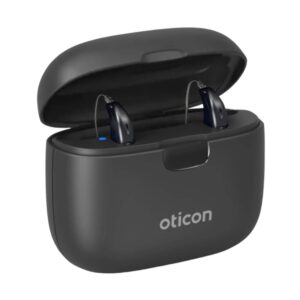
The battery sits sealed inside the hearing aid. You don’t remove it. Instead, you place the aids in a charging case each night, and inductive contacts transfer power directly to the internal battery while you sleep. Most chargers also serve as a storage and protective case during the day.
A few things affect how long a charge actually lasts in real-world use:
Manufacturers report battery life under standardized conditions, which usually assume moderate streaming and normal amplification use. Real-world numbers, especially with heavy streaming, will be lower — and we’ve included both figures throughout this article so you know what to actually expect.
For a deeper look at how lithium-ion chemistry affects long-term battery health, a life cycle assessment from Ramboll Management Consulting (commissioned by Signia) found that for rechargeable hearing aids, the battery solution accounts for only about 5% of total environmental impact over a device’s lifetime, compared to over 80% for disposable battery models.

The practical benefits go beyond just skipping a battery run. Here’s what rechargeable hearing aids actually deliver in daily life:
For older adults specifically, the dexterity and reliability advantages are significant. The best hearing aids for seniors consistently rank rechargeable technology near the top of their feature priority lists for exactly this reason.
The brands don’t all charge the same way. Here’s how each one handles it.
Phonak uses sealed lithium-ion batteries across their rechargeable lineup and offers a range of charger types: a standard desktop charger, a portable charging case with additional charges built in, and a Dry&Clean charger that combines charging with moisture protection. Their flagship Sphere Infinio Ultra pushes battery life to 56 hours under standard conditions — the longest in their lineup by a wide margin, thanks to a more efficient dual-chip architecture.
Starkey’s rechargeable models consistently hit 51 hours on a single charge, from their older Evolv AI through to the new Omega AI flagship. Their portable charging cases are particularly practical — the case itself holds enough charge for multiple full cycles, making it useful for travel without a wall outlet. The Omega AI’s case is rated to deliver a full 51-hour charge even away from a power source.
ReSound’s newer models use a dual-chip architecture (a dedicated DNN chip plus a standard processor) that runs AI processing continuously rather than on demand. The tradeoff is that battery life is more variable: 30 hours standard, 20 hours with heavy streaming and Intelligent Focus enabled, and as low as 10 hours under extreme DNN processing loads. The Vivia compensates with an impressive quick-charge: 10 minutes equals 2.5–2.7 hours of use.

Signia offers more charger variety than any other brand — desktop, portable, and Dry&Clean options across their RIC lineup, plus Qi wireless charging on the Active Pro IX, Silk Charge&Go IX, and Styletto IX. The trade-off on some of those stylized form factors (particularly the Styletto) is shorter battery life. Their Pure Charge&Go IX BCT balances strong battery life (36–39 hours) with universal Bluetooth Classic connectivity, which can be more power-hungry than LE Audio but delivers broader device compatibility.
Oticon’s Real models offer 24 hours on a charge — solid standard performance. Uniquely among the brands we carry, Oticon also makes disposable battery versions of the Real, giving users the flexibility to switch between power sources. Their SmartCharger portable case doubles as a travel charger. The Bluetooth connectivity guide covers how Oticon’s LE Audio Bluetooth stacks up against other platforms if you’re comparing streaming performance.
The numbers below represent standard battery life (normal amplification use, moderate streaming where applicable) and heavy streaming life where the manufacturer provides it.
Phonak Audéo Sphere Infinio Ultra (I90 / I70) The flagship Phonak model uses a dual-chip system — the DEEPSONIC AI chip paired with the ERA processor — which delivers extraordinary battery life despite running 53x more processing power than previous generations. I90 hits 56 hours standard; with heavy streaming and full AI engagement, expect 16–18 hours. Quick charge: 15 minutes for several hours of use.
Phonak Audéo Infinio Ultra R (I90) The single-chip ERA sibling to the Sphere. Battery life drops to 24 hours standard, with 16–20 hours during heavy streaming. Same quick-charge capability as the Sphere. A strong choice when the Sphere’s dual-chip pricing isn’t warranted by your lifestyle.
Phonak Audéo Lumity (L90 / L70 / L50 / L30) Phonak’s previous flagship and still an excellent mid-tier value. 24 hours standard, 16–20 hours with streaming. Quick charge: 15 minutes. All four technology levels (L90 through L30) share the same rechargeable platform. Curious how long these hold up over years of use? The Phonak hearing aid lifespan guide covers exactly that.
Starkey Omega AI (24 / 20) The newest Starkey flagship, featuring the G3 Gen AI Neuro Processor with 4x the memory and 3x the compute power of its predecessor. Despite that processing muscle, battery life holds at 51 hours standard and 24–30 hours with heavy streaming. The portable charging case carries its own 51-hour charge, making this genuinely practical for multi-day travel.
Starkey Edge AI (24 / 20) The previous Starkey flagship, now positioned as a strong advanced-tier option. Same 51-hour standard battery life, with streaming runtime of approximately 30–40 hours — slightly better than the Omega AI under heavy streaming conditions, due to less aggressive AI processing.
Starkey Genesis AI (24 / 20 / 16) The mid-range Starkey model. Shares the 51-hour standard battery spec across all three technology levels. A reliable, efficient rechargeable option with Starkey’s DNN processing at a more accessible price point.
Starkey Evolv AI (2400 / 2000) Starkey’s value-tier rechargeable. Standard battery life reaches 51 hours on the RIC-RT model or 38 hours on the custom rechargeable version. Worth noting: the Evolv AI uses older MFi-only Bluetooth, which limits Android streaming and accessory compatibility compared to newer Starkey models.
ReSound Vivia (9 / 7 / 5) ReSound’s current flagship and the world’s smallest AI-powered hearing aid. Its always-on DNN processes 13.5 million training sentences worth of sound intelligence continuously, which is why the battery numbers have a wider range than most competitors: 30 hours standard, 20 hours with streaming and Intelligent Focus active, 10 hours under extreme DNN loads. Quick charge: 10 minutes for 2.5–2.7 hours. Full charge in 3 hours.
ReSound Nexia (9 / 7 / 5) ReSound’s previous generation model, notable for being the first LE Audio hearing aid on the market. 30 hours standard, approximately 20 hours with streaming. Quick charge available. Desktop charger standard; premium portable charger available separately.
ReSound Omnia (9 / 7 / 5) The older ReSound platform, now positioned as a solid value option. Battery life runs 24–30 hours on the full-size RIC, 24 hours on the mini RIE. Quick charge: 30 minutes delivers 8 hours of use. Important limitation: the Omnia can only connect to one Bluetooth device at a time, unlike newer ReSound models.
Signia Pure Charge&Go IX BCT (7IX / 5IX) The standout Android-friendly option across our entire lineup. Bluetooth Classic connectivity means it pairs with virtually any Bluetooth device — iPhone, Android, tablet, laptop, or Smart TV — with full hands-free calling on both iOS and Android. Battery life: 36–39 hours standard (including 5 hours of streaming). Quick charge: 30 minutes delivers several hours of use. No tap controls on BCT models, but the Signia Assistant app handles adjustments around the clock.
Signia Active Pro IX The earbud-style option — designed to look like wireless earbuds while functioning as prescription hearing aids. 34 hours without streaming, 29 hours with 5 hours of streaming included. One of three Signia models with Qi wireless charging, so you can charge it on any Qi pad. Battery charges fully in 4 hours; portable case holds 3 full charges.
Signia Silk Charge&Go IX (7IX / 5IX / 3IX) The only instant-fit CIC on the market with advanced hearing aid features — and it’s rechargeable. Battery life runs 20–28 hours. Qi wireless charging via the included portable case, which holds up to 4 full charges. Important caveat: the Silk has no Bluetooth streaming capability (the device is too small for a Bluetooth chip). App control works via proprietary high-frequency signals instead.
Signia Styletto IX (7IX / 5IX / 3IX) The fashion-forward option with ultra-slim metallic design. The aesthetic trade-off is battery life: 16–20 hours, the shortest in our rechargeable lineup. Quick charge in 30 minutes. Qi wireless charging. The portable case holds 4–5 full charges, which helps compensate for the shorter per-charge runtime.
Oticon Real (1 / 2 / 3) Oticon’s BrainHearing technology is designed to work with the brain’s natural sound processing rather than simply amplifying everything. The Real delivers 24 hours standard, approximately 20 hours with streaming. Quick charge available. Desktop charger standard; SmartCharger portable case available. Oticon Real also offers disposable battery versions for users who want that flexibility — rare in this market segment.
When you forget to charge overnight or need a quick top-up before heading out, these are the numbers that matter.
| Model | Quick Charge Time | Use Time Gained | Full Charge Time |
|---|---|---|---|
| ReSound Vivia | 10 min | 2.5–2.7 hrs | 3 hrs |
| ReSound Nexia | Quick charge | Several hours | 3 hrs |
| ReSound Omnia | 30 min | 8 hrs | 3 hrs |
| Phonak Sphere Infinio Ultra | 15 min | Several hours | 3.5 hrs |
| Phonak Infinio Ultra R | Quick charge | Several hours | 3.5 hrs |
| Phonak Lumity | 15 min | 6 hrs | 3 hrs |
| Starkey Omega AI | Quick charge | Several hours | 3.5 hrs |
| Starkey Edge AI | Quick charge | Several hours | 3.5 hrs |
| Starkey Genesis AI | Quick charge | Several hours | 3.5 hrs |
| Starkey Evolv AI | Quick charge | Several hours | 3.5 hrs |
| Signia Pure Charge&Go IX BCT | 30 min | Several hours | 3.5 hrs |
| Signia Active Pro IX | Quick charge | Several hours | 4 hrs |
| Signia Silk Charge&Go IX | Quick charge | Several hours | 4 hrs |
| Signia Styletto IX | 30 min | Several hours | 4 hrs |
| Oticon Real | Quick charge | Several hours | 3 hrs |
Note: “Several hours” reflects manufacturer quick-charge language where exact minute figures aren’t published. ReSound Vivia is the most precisely specified at 10 minutes for 2.5+ hours.
A few simple habits extend the life of your lithium-ion battery significantly.

The best rechargeable model depends heavily on your priorities, not just raw battery numbers. Here’s a quick orientation:
Every model above is available with a 60-day risk-free trial through Injoy Hearing. We’re authorized dealers for Phonak, Starkey, ReSound, Signia, and Oticon, which means your manufacturer warranty is fully valid — not voided like unauthorized sellers. Our licensed hearing care providers handle all fittings remotely with unlimited adjustments included.
Ready to find your match? Contact our team and we’ll help you narrow it down based on your hearing loss, lifestyle, and priorities — no pressure, no guesswork.
Battery life ranges from about 16 hours (Signia Styletto IX, Sennheiser All-Day Clear) to 56 hours (Phonak Sphere Infinio Ultra). Most models fall between 24 and 51 hours. Streaming audio reduces runtime significantly for all models — typically by 30–50% under heavy streaming conditions.
No. Modern lithium-ion hearing aids use charge management circuits that stop charging once the battery is full. Leaving them in the charger overnight is safe and actually recommended for consistent performance.
Most hearing aid batteries are designed to retain adequate capacity for the expected 3–5 year lifespan of the device. Like all lithium-ion cells, capacity gradually decreases over hundreds of charge cycles. If battery life noticeably declines before the device otherwise needs replacement, most manufacturers can replace the internal battery as a service.
Most models support quick charging that delivers several hours of use from 10–30 minutes of charging. The ReSound Vivia is the most impressive at this, delivering 2.5+ hours from just 10 minutes. Portable charging cases on Starkey and Signia models also provide backup charges without needing a wall outlet.
Most premium rechargeable models carry an IP68 rating, meaning they’re dust-tight and can withstand submersion in up to 1.5 meters of water for 30 minutes. That covers sweat, rain, and accidental splashes comfortably. Some older and entry-level models have lower protection ratings, so check individual specs.
Almost all of them do. The exception in our lineup is the Signia Silk Charge&Go IX, which is too small to include a Bluetooth chip and uses proprietary signals for app control instead. Every other rechargeable model we carry supports Bluetooth streaming to iOS devices; Android full hands-free calling varies by model.
Charge nightly. Lithium-ion batteries perform better and last longer with regular partial charges rather than full discharge cycles. Running them completely flat regularly will reduce long-term battery capacity faster than consistent nightly charging.
TL;DR: The ReSound Vivia 9 vs Starkey Omega AI 24? Two of the most advanced hearing aids available. Both are current-year flagships with serious AI

TL;DR: Not all online hearing aid sellers are the same. Some have licensed professionals. Others don’t. Some honor warranties. Others can’t. Here’s the guide to
TL;DR: Phonak is the gold standard for noise performance and battery life. Signia is the gold standard for Bluetooth versatility and design variety. Both make

TL;DR: Phonak and ReSound are two of the most respected hearing aid brands in the world, but they take very different approaches to sound processing,